Wednesday, 15 June 2011

The Old Jewish Quarter Guided Walk 1.6.11

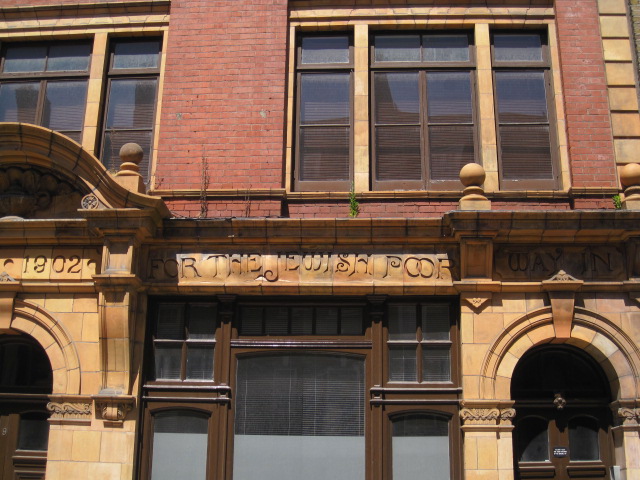
This walk traces the history of London's Jewish community in the East End. Set amid the alleys and back streets of colourful Spitalfields and Whitechapel, it's a tale of synagogues and sweatshops, Sephardim (comes from the Hebrew word for Spain) and soup kitchens.
I found it fascinating how the East End backed so closely onto the City. Having walked around some of the back streets we went to visit the Bevis Marks synagogue which is thoroughly to be recommended. We were given a talk about the history of the synagogue and about its function today. It is an amazing building tucked away among many modern structures.


The synagogue, affiliated to London's historic Spanish and Portugese community, is the oldest synagogue in the United Kingdom still in use. It is the same today as it was 300 years ago, except for the roof which was destroyed by fire in 1738 and repaired in 1749. Being located in the city's financial district, the synagogue suffered some collateral damage from the IRA Bishopsgate bombing in 1993, but it was later restored. The interior is well worth a visit. There is a small entrance fee.


Petticoat Lane market    


A soup kitchen for the Jewish poor

The houses above were built originally for the Huguenots (they were driven from France during a series of religious persecutions) who came here to settle in the 17th century. They were then taken over by the Jewish community, then by the Bangladeshis and are finally becoming residences for the more up and coming! It is located quite close to Brick Lane which is the heart of the city's Bangladeshi community and is known to some as Banglatown. It is famous for its curry houses.
 
We completed our walk opposite Spitalfields Market which is definitely worth a visit. It has many stalls ranging from clothes to food. I even managed to get a piece of wheat-free cake!


Highgate Cemetery Tour 28.5.11

I have always wanted to visit Highgate Cemetery after seeing it used as a backdrop in various films over the years. It looked quite atmospheric and spooky on the screen and I wanted to see if it was the same in reality. It certainly was! The West Cemetery is the one with the spooky atmoshpere and you need to book a guided walk round it. It is well worth it as they take you to various graves of interest. You can also visit the East Cemetery over the road. You have to pay again, but do not need to go on a tour - you can just wander at will.


Karl Marx's grave in the East Cemetery

Little Venice to Camden Lock

25.5.11
Little Venice is the point where Regent's Canal meets the Grand Junction Canal. It may not have quite the glamour of Venice, but it has its own picture-postcard charm. The canal is lined with weeping willows, and flanked by graceful stucco Regency mansions, many designed by the celebrated architect John Nash. An island in the centre is called Browning's island, after the poet Robert Browning who lived nearby.
The Regent's Canal was originally built to link the Grand Junction Canal's Paddington arm with the Thames. It was named after the Prince Regent, later King George IV. It was opened in 1820 at a total cost of £772,000, twice the original budget. It faced several engineering glitches in its first year, but later became an important artery for cargo passing through London.

You can stop for a drink and a snack next to the canal and after you are suitably refreshed take a canal trip down the canal with the London Waterbus Company to Camden

Saturday, 11 June 2011

Westminster Guided Walk

25.5.11
My second guided walk led me to Westminster. To start we looked at the heraldry of this area. A crowned portcullis is the symbol of Parliament and of the City of Westminster. Once you start looking you see it everywhere!The new parliamentary office building is called Portcullis House - its roof is essentially a portcullis.
Have a closer look at Big Ben. Directly below the apex there are six gilded windows. Inside the room behind the windows there is a powerful lantern. This is lit when Parliament is sitting at night. This is the time to visit and watch Parliament in action from the Strangers' Gallery as there is unlikely to be a queue!
Another interesting curiosity is the lamp standard on the corner of the fence. It's the House of Commons taxi lamp. It flashes on and off when an MP wants a taxi!

If you keep walking along the front of the Houses of Parliament you will eventually come to the statue of Emmeline Pankhurst (née Goulden; 14 or 15 July 1858 – 14 June 1928) who was an English political activist and leader of the British suffragette movement, which helped women win the right to vote. In 1999, Time named Pankhurst as one of the 100 Most Important People of the 20th Century, stating: "she shaped an idea of women for our time; she shook society into a new pattern from which there could be no going back".[1]
Although she was widely criticized for her militant tactics, her work is recognized as a crucial element in achieving women's suffrage in Britain. However, historians disagree about the effect of her activity on public support for the cause.[2][3]
If you walk across the grass you will find yourself with the view of the Houses of Parliament that is often used when interviewing MPs on the television. You will also come across the small but rather beautiful building which celebrates the abolition of slavery.


And of course, no tour of Westminster would be complete without Westminster Abbey. Its formal name is the Collegiate Church of St. Peter at Westminster and it was first built by Edward the Confessor in the mid-eleventh century who wanted to be buried where St. Peter was supposed to have walked. You have to pay to enter and visit except if you want to attend a service. I thought it would be rather lovely to end the day with an Evensong service, but as my luck would have it, it was closed that day due to some concert!


Wednesday, 8 June 2011

Hampstead Village guided walk

A good way to explore London on foot is to join a guided walk. 'London Walks' is an organisation which conducts guided tours every day of the week and at all times of the day and evening. You simply meet up at the nearest tube station to the walk you have chosen. They normally take around two hours. 

My first walk was around Hampstead village. Hampstead has been described as London's skybox as it affords the best views in London.  The guide (Richard 111 - so called because there are five guides called Richard!) took us round the backstreets of the village showing us the houses of the rich and famous. It is a leafy, pretty suburb and you have to have plenty of money to live here!  The photo below shows Church Row - the finest Georgian street in London.

 -
 
 The Admiral's house is well worth a visit. It is situated in Admiral's walk off Hampstead Grove. The story goes that it belonged to an eighteenth century seadog who bought and sold slaves. The truth is a little more banal - it belonged indeed to a naval man - Lieutenant Fountain North. The house was designed to look like a ship with its railings, fo'c'sle and two cannon!


On Hampstead Heath there are 13 ponds. The picture below shows a dew-fed pond (as opposed to spring-fed). There are ramps at either end of the pond. In the days of horse-drawn traffic it was really hard work for the horses hauling carriages and wagons up the hill and the pond allowed the horses to have a drink and also, more importantly, to rehydrate the wooden wheels to ensure braking was possible on the way down.


At the top here there is a sensational panoramic view of London.

If you enjoy visiting National Trust properties there is a gem hidden among the houses. Fenton house is a 17th-century merchant's house virtually unaltered during more than 300 years of continuous occupation. There is an interesting collection of early keyboard instruments and a beautiful walled garden with topiary hedges and fine mixed borders. There was a magnificent view of London from a small balcony right at the top of the house. I enjoyed some peaceful moments sitting in the garden and resting my feet!


Tuesday, 31 May 2011

My first exploration of the local area - Shadwell and Limehouse Walk

My first stop was St. George's Town Hall which has a striking mural depicting the fight between local residents and the British Union of Fascists in 1936.


I went on to Tobacco Dock - a Grade 1 listed building. Built in 1811 it was a store for tobacco, and in later years, sheepskins and furs. The unusual iron columns and superb brick vaults were nineteenth-century architectural innovations.


After a pleasant walk I came to Shadwell Basin which was built in 1858 to provide the space needed for ships which had outgrown the London Docks. It is used today by a water sports centre.


I followed the riverside walkway which gave some amazing views of Canary Wharf and came out by the Narrow Street Restaurant mentioned earlier.


I then walked inland to the Limehouse Basin. It was built in 1812 to serve inland waterway barges using the Regents Canal and was enlarged in 1820 to accommodate seagoing vessels. The Basin also connects the Grand Union Canal to the Thames. Today it is an area developed into flats.


My last viewing was of St. Anne's Church. It was built in 1714 by Nicholas Hawkmoor. The clock face came from the same workshop that provided the faces for Big Ben. It is one of the highest church clocks in the century.

Monday, 30 May 2011

Katherine's visit to London.


17.4.11
Katherine came to the flat for a pre-birthday visit. As it was such a lovely day on the Sunday we decided to go on a river cruise from Greenwich to Tower Bridge. Full commentary was provided, not that everyone listened. Katherine and Harry enjoyed kitkat and fizzy drinks!
In the evening we had a take away and went on to the pub down the road 'The Grapes'. It sits on the river and has a tiny wooden terrace overlooking the water. Katherine managed to smash a glass in her drunken stupour! We hastened out!

18.4.11
We wanted to experience the river clipper (the fast boat service) so got that from near here to Embankment. Katherine was feeling a bit hungover and the waves made her feel a bit queasy. We then made our way to Kensington Gardens because I had always wanted to visit Princess Diana's memorial fountain. Before visiting the fountain we decided to have lunch at a cafe by the lake.


We both liked the fountain and felt it reflected what Diana would have wanted. Despite the notice asking children not to stand/play in it, all the children we saw were having a whale of a time playing in it! Keep Health and Safety away.


We then decided to visit Kensington Palace as they had a special exhibition on called 'The Enchanted Palace' which was rather lovely. Katherine got herself crowned in the throne room.


In the evening we went our for dinner (tapas) at 'La Tasca' which was ok but not terribly hot. We then went back to the flat and celebrated Katherine's birthday, two days early, with a birthday cake (from Waitrose, of course!).